
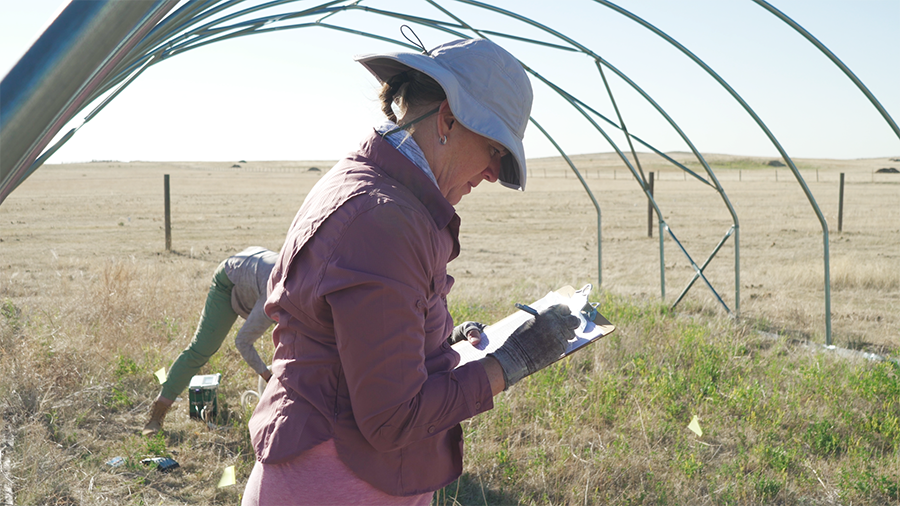
Extreme, back-to-back dry years that are as parched as the Dust Bowl, could leave 99% of some prairie ecosystems wiped out, according to a new international study led by Colorado State University researchers.
While the prairie grasses could come back, it would likely take decades, said Melinda Smith, the CSU biology professor who oversaw the research.
Over the four-year study period, during which researchers imposed experimental drought conditions on grasslands around the globe, including in Colorado, plant populations declined by 99% in some regions, Smith said.
“This is the first time to show this experimentally,” she said. “It doesn’t bode well for a future where these mega droughts occur more frequently.”

The peer-reviewed research, published in the journal Science, was able to closely examine the differences between moderate and extreme multi-year droughts. The grasses coped better in moderate, multi-year drought events when compared to events of similar duration but which were extremely dry. Because extreme multiyear events have historically occurred less frequently, they have been difficult to study until now, Smith said.
The new research provides scientists, range managers and cattle producers new insight into how to protect grasses and the food supply from ongoing reductions in rain and snow, as well as the higher temperatures associated with climate change, she said.
Colorado’s current chronic drought cycle, that dates back to the early 2000s, isn’t as long-lasting or severe as the Dust Bowl conditions Smith and her team modeled.
Some farmers who have spent decades raising cattle are skeptical of the severity of the problem. Gene Manuello, a veteran cattle producer on Colorado’s Eastern Plains near Sterling and former president of the Colorado Ag Water Alliance, said he isn’t particularly alarmed by the research because he’s not convinced the drier periods are occurring more frequently or in ways more damaging than they have in the past.
“Do we have droughts? Yes we do, and we have to deal with it, but we have to deal with wet times too. This year we didn’t know if we would be able to run cattle because the year started out so dry. But sometime in July, we started getting quite a bit of precipitation so we ended up with plenty of grass and it was good grass,” he said.
Colorado’s $4.9 billion cattle industry is a major economic sector, said Todd Inglee, a division director who tracks cattle for the Colorado Department of Agriculture.
He said the notion that we’re in a new era of drying is widely discussed.
“Producers are keenly aware of this drying trend due to history,” Inglee said, referring to the Dust Bowl in the 1930s. “Some believe that we have entered a new 20-year phase. But they have managed through these changes before. And advancing technology is allowing industry to make better decisions,” he said, including using satellites and drones to monitor the prairies, and track rainfall and snow.
“We know we have to care for these resources for our animals to thrive and do well,” Inglee said.
The cattle industry in Colorado and nationwide has been shrinking in terms of herd sizes, largely because inflation has increased production costs so much that farmers are cutting herd sizes, Inglee said. But high prices are making up for that shrinkage and giving the industry staying power in the face of the challenges imposed by climate change.
Looking ahead, CSU’s Smith said prairies will have to be more closely monitored and ranchers will have to move quickly to shift herds off of fragile lands whose grasses need time to recover from the dry spells.
In addition, she said that because the research shows recovery is slow and difficult once the plants have died, scientists, agricultural agencies and growers themselves, need to be thinking about large-scale reseeding efforts to aid the grasses’ comeback.
“There needs to be active management of these lands because we cannot rely on them recovering on their own,” Smith said. “During the Dust Bowl there were a lot of reseeding efforts that were successful, but it takes time. When it was left to the whims of nature, it took more than 20 years for some plant communities to recover.”
 Print
Print