Fourteen children ages 6 to 10 gather at Lake Lehow in Littleton, Colorado, on a bright summer morning. A collection of fishing rods waits in the dirt behind Andre Egli, statewide angler education coordinator at Colorado Parks and Wildlife (CPW), who is showing illustrations of the dozens of fish species that call Colorado home. The children listen with rapt attention, mouths agape. Then come the questions.
“If you catch a fish, can you touch it?” one boy asks. “What’s the biggest fish?” asks another. Others boast knowledge: “Know what? Beavers are bigger than coyotes.”
They race toward the fishing rods to practice casting. “Holy moly, I’m actually doing it!” one girl yells.
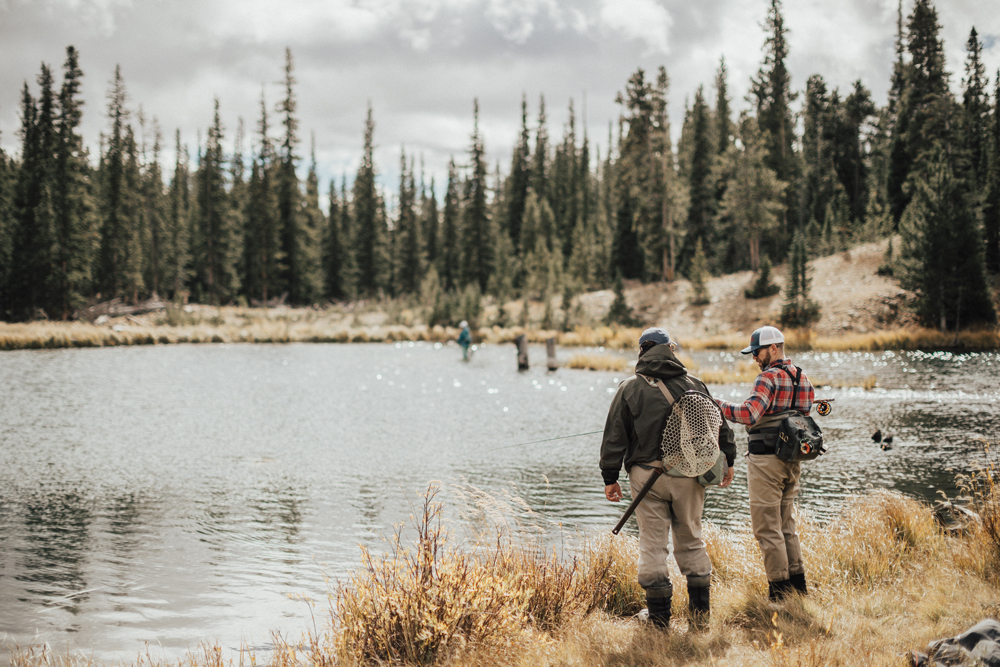
Fishing is anything but boring to these students. They approach the sport with a gleeful curiosity, inquiring about the places fish call home. In this way, fishing is a gateway to aquatic stewardship in Colorado. CPW and others are investing in fishing education, like the Lake Lehow clinic, as a way to protect and even regenerate ecosystems throughout the state.
Rooted in Rural Economies
Despite an arid climate with desert regions, Colorado has some of the best recreational fishing opportunities in the United States. Anglers enjoy a variety of landscapes for long fishing days, from high alpine lakes to wide, slow-moving prairie rivers. There are more than 35 species of catchable sport fish — including Colorado’s famed rainbow trout and kokanee salmon — within 6,000 miles of fishable streams and more than 1,300 fishable lakes and reservoirs.

An angler catches a native greenback cutthroat trout. Anglers need to know which species they have caught so they can decide whether to release or keep the fish.
iStock
But like skiing, hiking and camping in Colorado, recreational fishing is only possible through a significant investment of state resources.
Many of the fish that anglers pursue in lakes don’t naturally reproduce enough to make recreational fishing possible. Instead, fish hatcheries have supported Colorado fish populations since 1881. The majority of fish in many of the state’s waters are stocked by CPW’s 19 hatcheries that breed, hatch and rear more than 90 million fish per year. Additional fish are bred at federal and private hatcheries.
The recreational fishing industry — including hatcheries, private fishing and guiding, tour operators, marinas, gear stores, and more — provides thousands of jobs and injects money directly into local economies. And statewide efforts to protect and manage natural resources also benefit: Revenue generated from hunting and fishing comprises about 70% of CPW’s wildlife management funds, which support habitat restoration, regulation enforcement, research, and public education. This means that every fishing license sold — some 800,000 annually — directly funds conservation.
“The conservation efforts of CPW and all the fishing clubs, it is a positive effect overall for the whole wildlife system. The fish stocks are regulated very well and controlled very well,” says Martin Harris, Trout in the Classroom coordinator for the nonprofit Trout Unlimited (TU). “From what I’ve seen in my 80 years, I think it’s been very positive.”
But many argue that recreational fishing’s real impact is simply getting people outdoors and into the wild: The more anglers get out on the waters, the more they care about the fish and aquatic ecosystems that make the sport possible.
Raising New Generations of Anglers
Anglers play an important role in helping to manage the state’s fisheries, says aquatic biologist Jim White. Each year, CPW pays them to catch and remove invasive species. For example, Ouray County’s Ridgway Reservoir Smallmouth Bass Classic, now in its 10th year, is awarding $10,000 to the angler who harvests the most smallmouth bass, an invasive species that was illegally introduced to the area. This helps keep the population under control and minimizes its threat to native species.

A park ranger at Rocky Mountain National Park teaches a young child to use a fly rod. “Connecting youth to outdoor activities is critical to their mental development and plants seeds for future conservation of natural resources.” -Fisheries biologist Ben Zimmerman
Anglers need to know which species they have caught, though, so they can decide whether to release or keep the fish. Education is key, and CPW has invested heavily in educating new and seasoned anglers alike.
Egli alone runs about 150 fishing clinics per year, plus there are dozens more organized by regional coordinators. The clinics serve almost everybody, ranging from children to retired veterans. Some classes even teach attendees to fillet and fry their catches.
These programs leave a lasting impact on participants, says Egli. One fly fishing clinic participant, who is now semi-retired, volunteers with CPW to help teach new anglers. For Egli, these programs can go a long way in inspiring individuals to take action.
“People go to a zoo and see an animal that lives on the other side of the Earth, but because it looks cool, maybe they want to learn a little more. They might learn that [the animal is] in danger because of palm oil farming, or something like that, and then they stop buying things with palm oil. I think [fishing] can have that same effect,” says Egli.
Whether it’s cleaning up a pond or preventing litter in waterways, “being out there and actually seeing it firsthand, I think can make people take the necessary steps to become active in conservation.”
CPW isn’t the only organization connecting fishing education to aquatic stewardship. For example, Harris helps coordinate TU’s Trout in the Classroom program. Each year, students, ages 5 to 18, raise about 200 eggs in 55-gallon tanks in their classrooms, later releasing them into waters across the state. This is TU’s most impactful program, Harris says.


Children check on the juvenile fish they’re raising through Trout in the Classroom, a program by Trout Unlimited to connect youth to fishing education.
Courtesy of Trout Unlimited
“We’re basically creating a mini hatchery,” says Harris. “Raising a generation of people [to be] aware of their local watersheds and how to preserve the ecosystems.”
Trout in the Classroom has been running for about 15 years. Several schools have since expanded the program to include more biological education. The schools collect data from the tanks for a citizen science project, which is now comprised of more than 20,000 data points around how water chemistry changes and impacts fish populations.
Fourth graders in Ignacio are similarly raising roundtail chubs, a rare species of special concern, through the Southern Ute Wildlife Resource Management Division. They learn about healthy water quality, fish behavior, and endangered species conservation while caring for the aquariums.
Fisheries biologist Ben Zimmerman, who helps run the programs, says they integrate conservation in brief but memorable ways throughout the experience, such as encouraging students to count how many different birds they can see and hear while fishing.
“Connecting youth to outdoor activities is critical to their mental development and plants seeds for future conservation of natural resources,” says Zimmerman. “When we host these fishing activities, we have the opportunity to plant some seeds in their minds for conservation.”
Emily Payne is a writer covering the intersection of food, agriculture, health and climate. She is editor of the global nonprofit Food Tank.
 Print
Print