
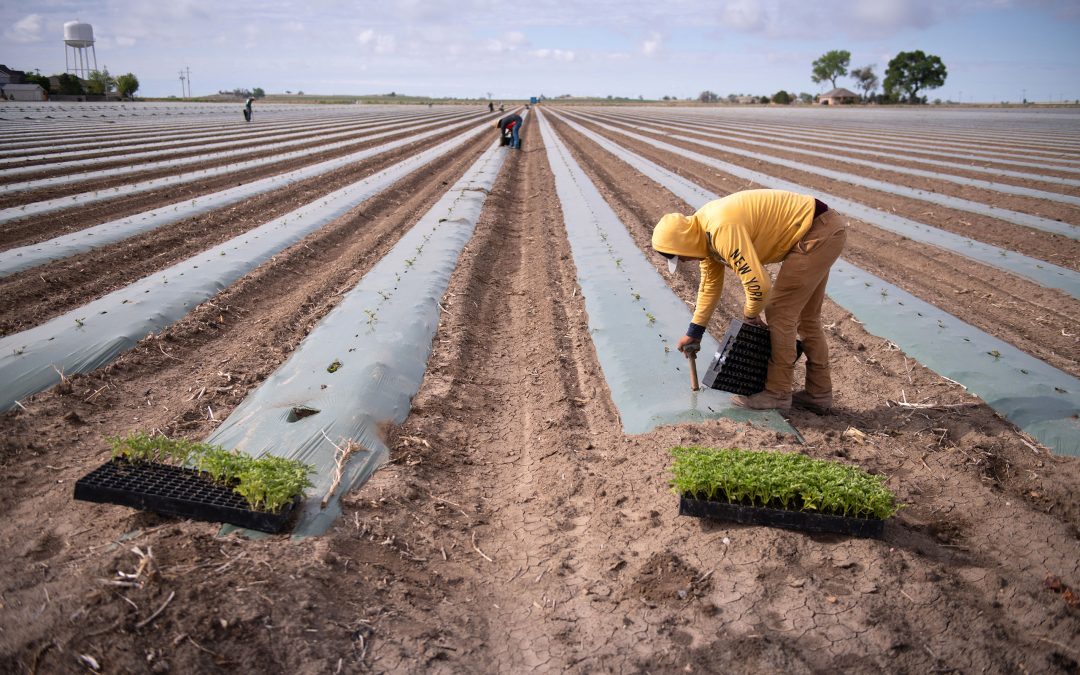
Aurora Water is in talks to purchase land and water from two of the most historic farms in the Lower Arkansas Valley, adding to farm communities’ worries about “buy and dry” pressure from cities amid historic drought and a dwindling agricultural economy.
But Aurora Water says it has learned lessons from past controversies and is structuring the latest buy-up to preserve southeastern Colorado farm life, not destroy it. Though Aurora Water and the farms say they are in nondisclosure agreements and can’t name the specific sites, Aurora says it wants the contracts to allow the farms to keep some working water every year.
“The farms that have the backing of a city . . . they may be the last farm standing because we have taken a lot of the risk away, or we will be taking risk away that the farmers currently have to struggle with on their own,” said Alex Davis, Aurora Water’s assistant manager for supply.

“I hope that people see the value of what we’re trying to do, and they see that we are really trying to share water with agriculture in a way that allows the city to thrive, and the local community and the agriculture to thrive,” Davis said. “That’s a tough nut to crack, but we think we’re doing it.”
Recent southeastern Colorado water purchases by Aurora Water and other utilities have given the agencies rights to dry up farmland in, for example, three out of 10 years. Many local farmers and water conservancy officials say that casts too much uncertainty on a farm owner’s economic plans. They are also not convinced that farmland can recover after being completely dried up for entire seasons.
Aurora Water says the deals it is negotiating now would be more like taking roughly 30% of the water in a given year, leaving the rest for the family farming to continue every year. That would fallow a similar portion of land to what southeastern farmers already fallow in crop rotations, Davis said. Aurora Water would buy the land and the water rights, and then lease both back to the existing family farm to operate.
Lower Arkansas Valley officials want to see details of Aurora Water’s agreements before judging whether the suburban utility is actually partnering with local farmers, or simply patronizing rural communities in new ways.
“Ultimately, it is up to individual landowners to decide what is best for their farms and their families. At the same time, this situation highlights a much larger issue for Colorado. Farmers need viable alternatives to selling their agricultural water to municipalities as they make decisions about the future of their farms and water rights,” said Jack Goble, general manager of the Lower Arkansas Valley Water Conservancy District.
The district and other southeast Colorado leaders have challenged past farm purchases by Aurora and Colorado Springs as a threat to the local culture and economy. They have demanded that cities and suburbs conserve more water before building more homes, and commit to preserving rural farming and tax bases when making water deals.
“If we want irrigated farming to remain a meaningful part of Colorado’s future, we need policies and conservation tools that allow farmers to benefit from the value of their water while supporting the agricultural economy and communities that depend on it,” Goble said.
Aurora Water says it has agreed to make “payments in lieu of taxes” to keep local communities financially whole in past agreements, and plans to with the new buy-ups as well.

Eric Hanagan, the family leader of Hanagan Farms in Swink that produces melons, chiles and other produce, said the farm is part of a non-disclosure agreement but did not identify the parties.
When told Aurora Water had said it was negotiating water rights deals that would allow longtime family farms to keep operating, Hanagan said, “Well, it’s important to us, and I think that’s why we have kind of pursued this, an interest in this path.”
That year, Aurora spent $80 million to buy nearly 5,000 acres of farms in Otero County and the more than 6,500 acre-feet of water associated with the land. An acre-foot equals nearly 326,000 gallons of water, enough to irrigate half an acre of corn, or supply at least two urban homes for one year.
Aurora plans to use that water itself in three out of 10 years, leaving it on the farms the rest of the time. Some 4,000 acres of land will be dried up intermittently when Aurora is using the water, according to those who helped negotiate the pact.
Data shows Colorado’s irrigated farmlands are shrinking. Since 1997, the state has lost 32% of these lands, with areas in the Lower Arkansas Valley seeing losses higher than that, according to an analysis of federal agricultural data by Fresh Water News and The Colorado Sun. Crowley County lost 90% of its irrigated lands in that period. Pueblo has lost 60.2%, and Bent and Otero have lost 37.6% and 35.2%, respectively.

In addition to losing farm tradition, agriculture jobs and tax base for local governments, the transfers of water to cities and suburbs in past decades left dried-up lands unplanted and unreclaimed. Colorado Springs and Aurora have agreed that decades-ago buyups were not handled properly, and they claim more recent agreements and a new state law include requirements for reseeding with native grasses and protections against erosion and decline.
Current water purchase negotiations are more realistic, Davis said, about how much of their water the farmers are using in a given year, and how much land is fallowed and goes unirrigated because of longer-term agricultural needs. Alfalfa, a very thirsty crop, is one example, she said. One planting of alfalfa can be harvested for five or more years, but then those fields need to lie fallow for a time before new alfalfa seed is planted.
“I think what a lot of farmers have realized, who would like to participate in the type of deal that we’re structuring here, is that all farmland eventually needs to be fallowed in order to keep the land healthy,” Davis said. “And so if you can have a rotational fallowing schedule that allows portions of the farm to be fallowed on a regular basis, and that’s the water that is moved to the cities, that works better for the farmers, and it works better for the cities.”
Any upcoming deals would not be a strict “30% a year” formula, Davis added.
“Some years, you might only fallow 10% of the farm, 10% of the water. Some years you might move 35% or 40% of the water, and it would be kind of balancing water availability with best farming practices,” Davis said. “We’re looking to prove that a city can really share water with farming operations and keep farms viable.”
 Print
Print